
Inside This Issue
This month we’re featuring:
Recent Wins
New Software – Union Hall
AFSCME Knight Cancer Group (KCG) Agreement
AI Advisory Committee
Don’t Let Management Write Your Staffing Plan Without You
Member Led Forum Update
Feedback Requested for Biohazardous Waste Disposal Guidance
SP Accretion Adds 100 New Union Siblings to 328
AFSCME 328 Social
Political Action Opportunities!
Singing 9 to 5 Karaoke Fundraiser
A Month In Labor History
Membership Meeting
Membership meetings are held on the first Wednesday of the month. The next occurrence will be Wednesday October 7th at noon. Be sure to register as soon as possible, due to the high volume of requests there can be delays.
President Office Hours
Do you have a question you’d like to ask our local’s President? There are several 30 minute open office appointments for you to have one-on-one conversations with the local’s president. Dues paying members can register here to get a meeting invite.

Recent Wins
--a guest post by Sierra Sullivan-Paul--
We recently settled two cases after a step 2 grievance was submitted using lower-level mitigation. A member received a "voluntary resignation" letter after being out on FMLA/PLO/STD, then became permanently disabled and going on Long-Term Disability (LTD). They’d done everything right and were following all the required steps for documentation and communication. After a meeting with ACC and Labor Relations we were able to get the member what she wanted and get ACC and Labor Relations to admit they had made an error due to multiple changes in leadership and etc. resulting in an inaccurate "voluntary resignation" letter to a member who was at that time also actively dealing with complications and hospitalizations due to their LTD. ACC rescinded the "voluntary resignation" and coded the departure as "medical separation" which they admitted they should have done. We were able to get this member placed on the Preferred Hiring List (PHL), for if there was ever a time they’re able to come back to OHSU. We also reassured and gave resources for their continued benefits through LTD and to essentially give a formal apology to our member.
Shortly after, another case involving "voluntary resignation" due to attendance and "no-call/no-showing" came up. Our member had been in communication with OHSU/LFG/PLO, following every step they could as best as they could. There were several mitigating factors to add complexity to the case compounded by OHSU refusing to communicate to PLO to confirm and verify our members employment. Ultimately what the member wanted wasn't to come back but was again a re-classification of the "resignation" and the ability to come back to OHSU. This time with their CRNA that they were able to get while out on leave receiving treatment. After another successful low-level mitigation, I met with the ACC, informing them of our member’s desire. Showing the documentation of clear effort to the best of our member’s ability to follow procedure and policy, ACC was able to confirm that there are no negative marks on the members file within OHSU. They ensured that the separation was not seen as voluntary resignation and that the member is encouraged to re-apply to OHSU with their new credentials.
In both cases the goal was not to come back to OHSU necessarily, but we were able to get what both members wanted from their grievance without having to escalate down the grievance path.
Interested in becoming a steward? - Sign Up Here.
New Software – Union Hall
We moved away from the Hub and onto a new software platform that we are calling Union Hall. The cutover date was 9/1.
Members can set up their own Union Hall account instead of waiting for an administrator to invite you. Click http://app.facautomate.com/claim to sign up.
You’ll enter your OHSU email address to get an account creation link email to you. If you don't receive an email, please contact it@local328.org.
What changes for non-steward membership? An updated view, easier navigation and new URL.
Once you’ve logged in you’ll have four tabs on the left hand side bar.
Dashboard – If you’re a steward, here is where you’ll be able to see the cases that have been assigned to you. For non-steward members this will be blank for now.
Calendar - This feature is going to continue to get upgrades. Soon it will show Steward On-Call, union meetings and any planned events.
Cases - Get help with an investigatory meeting, filing a grievance or ask a question. Your case information can be entered here for steward assignment and representation.
Library - The Library feature will be available for Dues-paying members only. It will host Monthly Membership Meeting Recordings, step-by-step guide for how to submit your case information, and other helpful information.
We're so excited to continue to improve and add more functionality to this new software, keep an eye out for our next feature; Voting!
If you have any questions or concerns, please contact the IT Committee at it@local328.org.

AFSCME Knight Cancer Group (KCG) Agreement
OHSU is creating a new entity called Knight Cancer Group (KCG) to take charge of cancer care and research at OHSU. All five AFSCME Locals have been in negotiations with OHSU about what this means for our members. After months of negotiations, we are pleased to announce we’ve reached in agreement, which includes the following protections:
1. Represented employees remain OHSU employees.
All current employees represented by AFSCME will continue to be employed by OHSU, not KCG.
2. All Contracts remain in place.
All represented employees will continue to enjoy all their current contractual rights in relation to both OHSU and KCG.
3. New employees at KCG will be Union members.
New employees hired to work in KCG doing work that is currently done by union members will all be a part of our unions.
4. OHSU will not lease employees from KCG.
OHSU is forbidden for “leasing” employees from KCG to do what would otherwise be union work. Our work remains ours.
Additionally, union leadership will meet with KCG President Brian Drucker to discuss the possibility of new positions for recently laid off members in KCI.
AI Advisory Committee
If you have a new AI program being executed in your work unit, please do not hesitate to reach out to the committee at AIAdvisory@local328.org with your thoughts!
- John Trammell - AFSCME 328 AI Advisory Committee Chair
- Eric Buzzard - AFSCME 328 AIGC Liaison
Don’t Let Management Write Your Staffing Plan Without You
Oregon’s hospital staffing law (HB 2697) always covered ambulatory clinics operating under a hospital license, but until the Oregon Health Authority assessed a ruling (and fines), OHSU refused to create ambulatory staffing plans. OHA’s ruling makes it crystal clear that OHSU is required to develop staffing plans for these settings, and we need YOUR help to create them!
We need ambulatory clinic members who are passionate about safe staffing and patient care, who want to hold OHSU accountable to the spirit of House Bill 2697, and are ready to bring coworkers’ concerns to the committee. This is a true opportunity to make a lasting impact for the better for so many of our members!
If you’re interested in serving as an ambulatory representative on the Staffing Committee, please fill out an application here. If you have any questions, feel free to contact safestaffing@local328.org.
Member Led Forum Update
We are still seeking proposals for a member-moderated open forum. See requirements and questions to consider in our March newsletter. Applicants are encouraged to send proposals to communications@local328.org

Feedback Requested for Biohazardous Waste Disposal Guidance
--a guest post by Helen Rappe Baggett, MS, RBP --
If you handle or dispose biohazardous waste at OHSU, Environmental Health and Safety (EHS) wants you to have the information you need to perform your job safely. Whether you work in Healthcare or Research operations, EHS wants to provide you with simple, clear and accurate disposal guidance to prevent accidental exposures to biohazardous materials.
EHS is expanding current biohazardous waste sorting guidance documents to improve clarity for all types of biohazardous waste disposal. We want to hear from you about how well our existing resources serve you and what improvements you would like to see.
Current EHS guidance for biohazardous waste disposal at OHSU includes the following:
The Healthcare Waste Sorting Grid contains information on biomedical waste disposal in Healthcare settings.
The Research Biohazard Waste Sorting Grid is directed to workers in Research settings who need to dispose of biohazardous waste.
Please review the grid that is relevant to your job, then take a moment to fill out this short survey. The survey is completely optional and anonymous. Data EHS receives will only be used to inform the modifications and updates we make to our biohazardous waste disposal guidance documents. The survey will be open through the end of October.
Your feedback will help us improve biohazardous waste sorting safety at OHSU!
Questions? Please contact the EHS Biosafety Team at ehs@ohsu.edu.
SP Accretion Adds 100 New Union Siblings to 328
--a guest post by Brian Saville Allard --
Simulated (or Standardized) Patients (SPs) are the lifeblood of the human simulation department on the 3rd floor of the RLSB (and four smaller units statewide). An ever evolving field, this position began decades ago as independent contractors brought in on a case by case basis, working out of repurposed rooms in Emma Jones Hall.
In 2014 OHSU opened the RLSB (then the CLSB) and the SPs were hired on as non-union employees with a temp classification. Their wage was raised from $15/hr to $20/hr. Later a secondary position of Senior Simulated Patient was created and experienced SPs were able to apply for this at a higher rate of (static) pay.
In 2023 a new SP Program Manager was hired. Emma Vick was promoted from an AFSCME position, and one of her first priorities was getting the SPs reclassified into the union. This finally came to full fruition (after three years of negotiation) in mid July this year when all 100+ SPs across five state-wide campuses were officially accreted into the union and reclassified as Flex employees, joining the 25 full time trainers, admins, and techs in the Simulation department as our siblings.
Currently Simulation Union Steward Brian Saville Allard is working with Steward Leadership and AFSME staff to onboard, orient, and educate these new AFSCME family members on their union rights, including annual ATB raises, shift differentials, Weingarten rights, and Just Cause.
This is the power of union organizing! 100 people now have better pay and better protections while they perform this highly skilled and specialized labor of simulating patients, providing feedback, and giving our learners a safe environment in which to practice their skills as they learn.

AFSCME 328 Social
--a guest post by Heather Whalon --
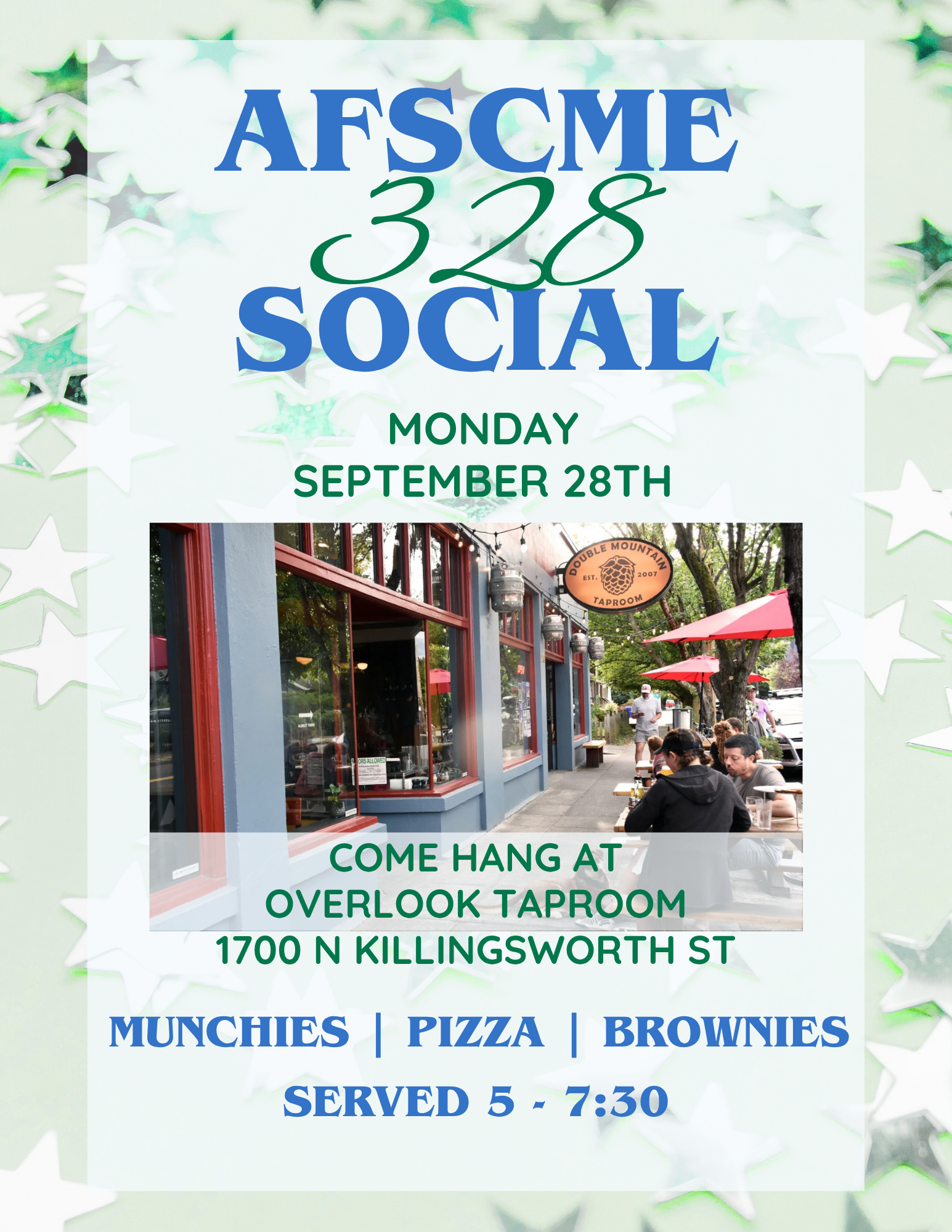
Members, Stewards, and All Employees Represented by AFSCME local are welcome to join for snacks and camaraderie each month on the 28th. Our first social will be next Monday, September 28th at Overlook Taproom (1700 N. Killingsworth St). This will be a no-host bar/event, but some pizza and snacks will be available for all who attend. Food served from 5-730.
Heather Whalon and Kate Schneider will be the host/point of contact when you arrive for this month's social!
Political Action Opportunities
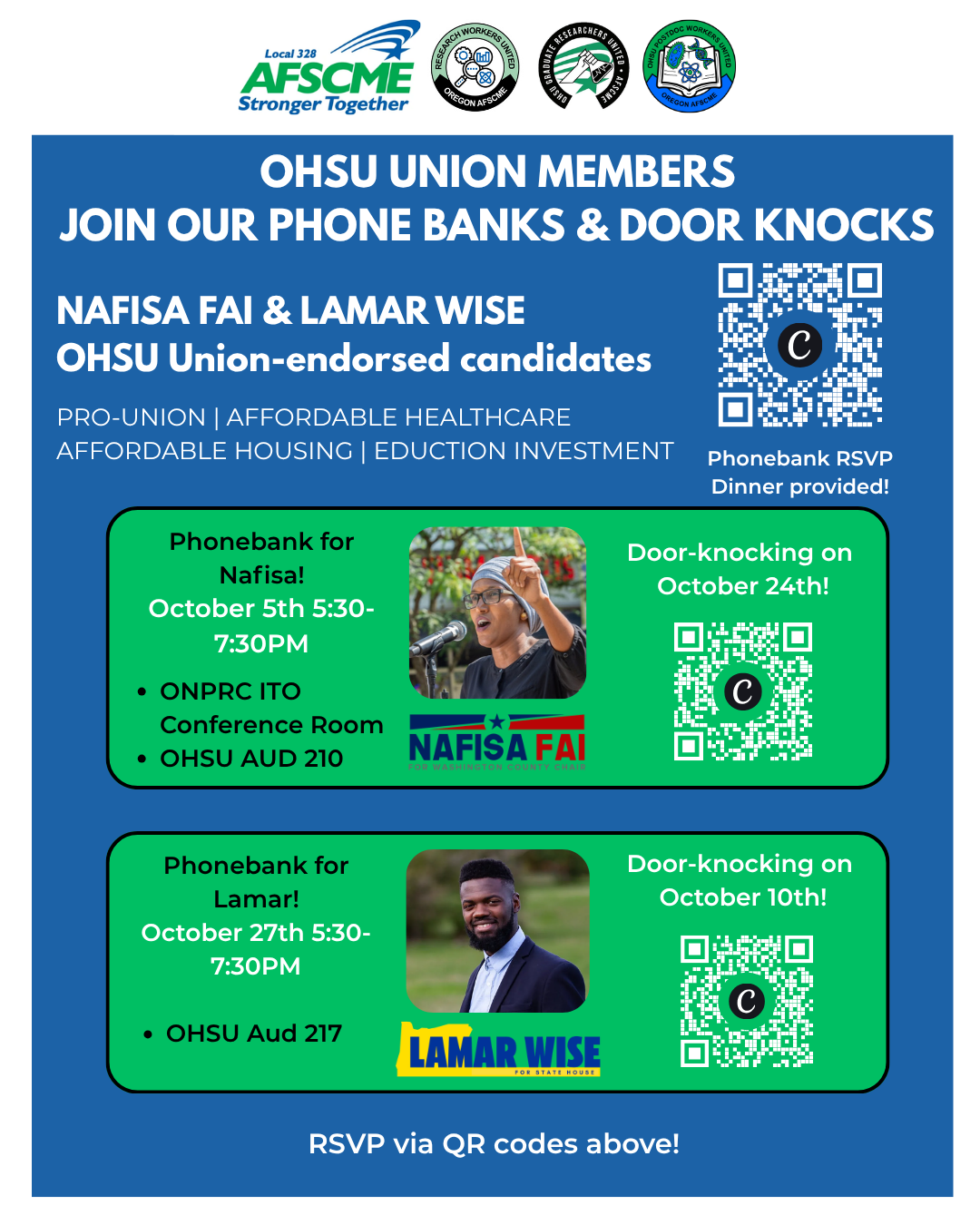
Come join us as we rally behind AFSCME's own, Representative Lamar Wise and Washington County Chair, Nafisa Fai. There will be both phone bank and canvassing opportunities for each candidate.
We'll be out in the community knocking on doors and speaking with voters to build momentum. No experience needed -- training will be provided. Please bring a charged phone, a water bottle, and comfortable walking shoes.
As a small-business owner, Commissioner Fai understands what everyday families are up against. Let’s get her reelected so she can continue to advocate for Washington County.
Lamar is running to represent House District 48, SE Portland and North Clackamas. During his first legislative session this year, he quickly became one of Salem's fiercest advocates for workers' rights. Lamar is ready to continue that battle in 2027 and beyond, but he'll need our support to win this pivotal election.
Singing 9 to 5 Karaoke Fundraiser
Megan Gallagher (Local 88) and JoAnn Gilmer (Local 189), have organized a karaoke party/fundraiser that is being held this Friday. This event, sponsored by Council 75, is open to ALL AFSCME members, their friends, and families; and is a fundraiser for Dolly Parton’s Imagination Library. The event is being held on Friday, 9/25 from 6-8pm at Pepe’s Restaurant and Karaoke Bar on Powell. This will be a fun and enjoyable event for all AFSCME members to help build solidarity while also helping our community. RSVP here!


This month, we’d like to speak briefly on the history of Labor Day, the national holiday dedicated to celebrating the accomplishments and continued struggle of Labor here in the United States.
In 1886, there was much debate around whether we should align with the international movement and celebrate May 1st as International Workers’ Day, or use a date in September that had been traditionally utilized by precursor labor groups like the Knights of Columbus.
At the same time, American unions were pushing for the instating of an eight-hour workday. In Chicago on May 3rd 1886, peaceful strike demonstrations towards this goal led to the deaths of several union members when police opened fire on the crowds. A day later, at Haymarket Square, a bomb was detonated that killed both police and civilians involved with that day’s demonstration.
The Haymarket Affair, as it came to be known, was international news, as was the ensuing trial and conviction of eight suspects. However, these ‘anarchists’ as they were described were likely entirely uninvolved in the events of that day, evidence presented was thin and could not prove that some of them were even in Haymarket Square at the time of the bombing. Despite this, the courts convicted and sentenced the eight to either death or life in prison. Subsequent governors of Illinois would commute or pardon all of the living defendants by 1893, clearly recognizing the miscarriage of justice that had taken place.
Because of the growing labor movement’s power, the Federal administration under Grover Cleveland was hesitant to approve May 1st as the official date of our nation’s Labor Day, worrying that it would become a commemoration of the Haymarket Affair and the strikes that occurred around it, bolstering the call for greater worker power and involvement in the halls of power.
In response to this political and social pressure, President Cleveland declared the First Monday of September to be Labor Day in the year 1894. Ironically, that very same year, the President deployed thousands of federal troops to violently suppress the Pullman Strike led by Eugene Debs.
Our Labor Day celebrations are much more peaceful these days but we should never forget that each and every privilege we enjoy in our modern era, from a simple holiday to the seemingly innocuous eight-hour workday, was fought for by those who came before. It is important to remember their sacrifice each and every Labor Day and try our level best to keep pushing for a better future for all workers as they did.
Solidarity Forever
Do you have a newsletter article or guest blog post? We’d love to hear from you, please submit your request here or email it to communications@local328.org.
AFSCME LOCAL 328 Union Officers
AFSCME Local 328 Contact Info:
President — Jennie Olson
Email: info@local328.org
Vice President — Jenn Roemer
Website: https://www.local328.org/
Secretary — Cassie Barton
Facebook: @AFSCME328
Treasurer — Kerry Moore
Instagram:@afscmelocal328
Chief Steward — Angelo Bologna